Posted in Tibetan Buddhism, Zen Buddhism

Zen and the Dalai Lama

Picture

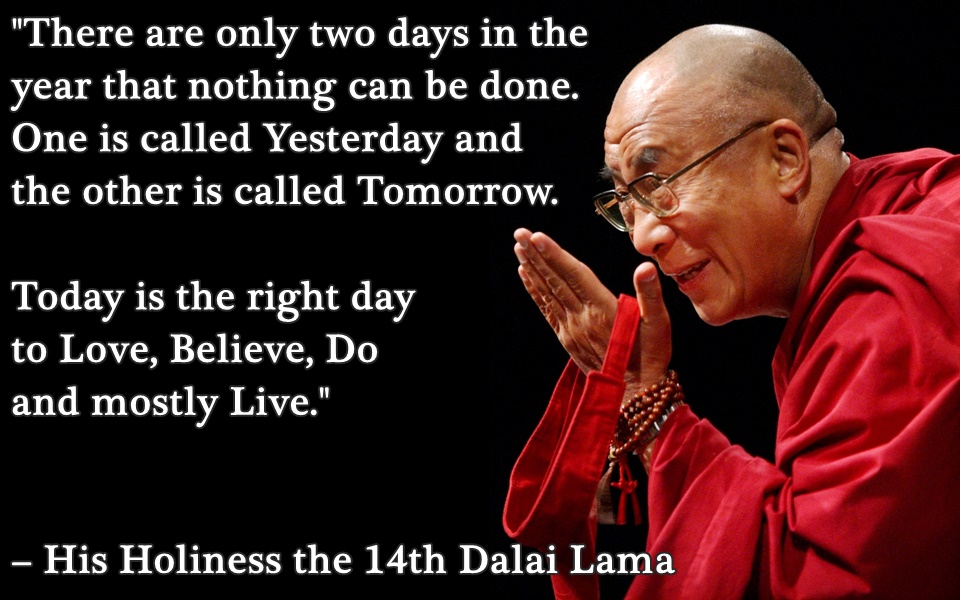
The Dalai Lama, the spiritual leader of Tibetan Buddhists, is coming to Southern California this summer.

“We’re Zen Buddhists. Who cares about the Dalai Lama?” you might think. It would be like a Baptist going to see the Pope.

Not exactly. The differences between the various branches of Mahayana Buddhism are much more about form than substance. To use another analogy from my Christian upbringing, the difference often is on the level of sprinkle vs. dunk for baptism. The core beliefs, and even practices, are surprisingly similar.

Vajrayana Buddhism, what we think of as “Tibetan,” is technicolor, and Zen is black and white. But both schools have meditation as their primary practice. Both teach on emptiness and the nature of mind. Both have as their goal the liberation of all beings.

An then there’s the fact that the Dalai Lama is a prolific author on Buddhism, a social activist, and a Nobel Peace Prize Laureate, and you have a man worth listening to.

Tickets go on sale April 2nd, and you can get yours here.

I’m going. Hit me up if you want to carpool.

~ Rev. Jăbō

Picture

Posted in Zen Buddhism

The Accidental Carnivore

or, Don’t Kill the Pig Twice

A lot has been written on whether it’s “better” for a Buddhist to be vegetarian. This is not one of those posts. The fact is that I am a vegetarian and have been for nearly 14 years. And yet I found myself eating pork recently. On purpose.

What happened was (my sister-in-law says it’s going to be a good story when it starts with “what happened was”) I was at a restaurant with my husband. I wanted the Quiche Florentine, which is vegetarian. My husband ordered for me, as he usually does, and he accidentally asked for the Quiche Lorraine instead. I suppose my mind was elsewhere (so much for mindfulness!), because I didn’t notice.

Until I put my fork into the quiche and found some animal flesh.

I could have sent the dish back and gotten the “right” one. But the restaurant would have had to throw it away, and the pig would still be dead. So I ate it. Mindfully.

Before I ate, I said a silent prayer for the animal or animals. (There could be meat from more than one in my dish. For simplicity, I’m referring to it here as one animal.) I acknowledged that it hadn’t offered itself voluntarily to me, but I thanked it just the same. I wished it a good rebirth, to realize enlightenment, and to save all beings from suffering.

My being a vegetarian isn’t about physical purity or spiritual perfection. It’s about being conscious of what I put in my body and about the choices I make in each moment.

Thank you, Piggy.

What are your thoughts on mindful eating? Please share in the comments below.

~ Rev. Jăbō

Picture

Posted in Zen Buddhism

Taking Refuge

Yesterday, my cousin killed himself.

I wanted a bag of Oreo cookies and a quart of ice cream. Chocolate Chip Cookie Dough.

But I’ve learned that there are healthier things to seek solace in than food: the Buddha, the Dharma, and the Sangha.

When we speak of “taking refuge” in Buddhism, we mean turning to those things which bring us comfort. Inappropriate refuge items are those that mask our emotions. They can include just about anything:

  • Drugs and alcohol
  • Sex
  • Food – there’s a reason some things are called “comfort food,” after all
  • TV and books
  • Shopping – retail therapy, anyone?

When we seek refuge in these things, we are seeking a way to “numb out” to the pains of life. We’re trying to hide from the reality of our situation instead of facing it, fully aware. It takes courage to live mindfully, and sometimes, we want to close our eyes, just for a little while.

I did this for a while last night. I hid in a work of fiction. At least these days, I know I’m doing it. I remember making the conscious choice to numb out for a few minutes, because I didn’t want to cry.

After a couple of chapters, I came to my senses. What’s wrong with crying? I miss Scott. I feel sad that he was in so much pain he opted to end it with suicide. I feel guilty that I hadn’t spoken to him since my Aunt’s funeral in 2010.

And do you know what? None of those feelings went away while I was hiding in my book. I had to come out and face the truth of my grief in order to assimilate it.

So I thought of Scott and cried. And then I stopped thinking and watched myself cry. I used my tears, rather than my breath, as the focus of my meditation. I felt them, really experienced them, as they ran across my skin. I tasted the salt. I became fully present for my mourning, without reliving old memories.

Like a fire with no fuel, my crying ended fairly quickly. It’s hard to sustain that level of internal pain when you’re not dwelling on it. Pema Chodron calls this process “letting the storyline go.” Just sit with the naked emotion, and see what comes up.

By meditating on my tears, I was taking refuge in the Dharma: the teachings of the Buddha. I used a process I’d been taught to find comfort. In the moment, it wasn’t about finding comfort, it was just about being in the moment. Yet I was comforted. My tears dried. My sobbing slowed and then stopped.

Then various teachings on the great work of life and death arose in my clear mind. How we are like clouds in the blue sky, appearing and disappearing – without any appearing and disappearing. More refuge in the Dharma.

I could have taken refuge in the Buddha, the man himself, the teacher. I do this when I consult my living teachers, which is usually weekly. Or when I think of stories from the life of the Buddha and see how he handled himself in various situations.

I did take refuge in my Sangha. Since I’m away from home, I posted a note about my cousin’s death on Facebook. The outpouring of love and compassion was overwhelming and instantaneous. My online community of Dharma brothers and sisters, some of whom I know in person and others only virtually, gave me refuge.

That’s what we mean by taking refuge: learn from the teacher, practice the teachings, reach out to the community on the path and let it enfold you in grace.

After my tears dried naturally, I chanted Jijong Bosal. I asked the Bodhisattva of Travelers and the Departed to guide Scott through the Bardo. I asked Jijong to help Scott have a good rebirth, gain enlightenment, and save all beings from suffering.

I no longer wanted the cookies and ice cream.

~ Rev. Jăbō

Picture

Posted in Zen Buddhism

“Buddha’s Brain” by Rick Hanson

Want to be happier? “Buddha’s Brain: the Practical Neuroscience of Happiness, Love, and Wisdom” has practical advice on how to do so, based on both neuroscience and Buddhism. Which is one of two reasons why I love it.

The other reason is the cool brain science stuff explained in plain English.

First take-away point: “Neurons that fire together, wire together.” You stimulate pathways in your brain often enough (the neurons firing), and after a time they decide to grow closer together (the wiring) so they can communicate more quickly. Result: You think happy thoughts, it gets easier to think happy thoughts.

Second take-away point: We create most of own suffering. “Only we humans worry about the future, regret the past, and blame ourselves for the present. We get frustrated when we can’t have what we want, and disappointed when what we like ends. We suffer that we suffer. We get upset about being in pain, angry about dying, sad about waking up sad yet another day. This kind of suffering – which encompasses most of our unhappiness and dissatisfaction – is constructed by the brain.”

Anyone else seeing the first two Noble Truths here?

Third take-away point: “Your brain is like Velcro for negative experiences and Teflon for positive ones – even though most of your experiences are probably neutral or positive.” And why is this? Because negative experiences may be dangerous, and you need to learn from them: the stove may be hot, don’t drive too fast, etc. Remembering last night’s sunset is not a survival imperative. No wonder we can be so unhappy so much of the time! It’s what we remember.

Fourth take-away point: Taking in the Good. “[C]onsciously look for and take in positive experiences. There are three simple steps: turn positive facts into positive experiences, savor these experiences, and sense them sinking in.” In other words, take time to smell the daisies.

I’ve barely scratched the surface of all the good stuff in this book. Hanson also has several guided meditation series, including “Meditations for Happiness: Rewire Your Brain for Lasting Contentment and Peace.”

I highly recommend anything with Hanson’s name on it. He melds the scientific and the spiritual in a way few others have dared, and with great clarity.

Have you read this book? Listened to these meditations? Please share your thoughts in the comments!

~ Rev. Jăbō

Picture

Posted in The Spiritual Life

New Year’s Transition

Ah, New Year’s. A time of change. A time to modify some of our behaviors. A time to make resolutions that we actually plan to keep this year.

But before we jump in to a whole new set of self-created challenges, let’s take some time to reflect. Grab a cup of your favorite warm, comforting beverage (mine’s hot cocoa) and your journal.

Journaling not your thing? Try getting on the phone with a dear friend. Or perhaps just read through these questions and answer them to yourself.

Learning from 2014:

  • What were some of your favorite moments?
  • What challenged you?
  • How did you spend your time?
  • What are you proud of?
  • What lesson will you hold dear?
  • What changed?
  • Who was significant in your life?
  • What were you loving this year?
  • What will you be glad to leave behind?
  • What do you want to remember?
  • What do you wish to celebrate?
  • In one word, 2014 was the year of… 

And moving onward…

Planning for 2015:

  • What do you want to invite into your life this year?
  • What would you like to learn?
  • Who do you want to become?
  • What’s one thing you’d love to accomplish?
  • What word or phrase will guide you through this year?
  • What do you want to be celebrating next December?

In Buddhism, we always talk about how the present moment is the only one we have. Sometimes, the present moment is best used in learning from the past and planning for the future. Happy New Year!

Thanks to Jamie Ridler for her kind permission to use these questions, which first appeared in her newsletter as part of “Honouring and Celebrating This Year of Your Life.” She has a podcast on the topic, where she guides us through these questions.

~ Rev. Jăbō 

Picture

Posted in Uncategorized, Zen Buddhism

Bodhi Day

After traveling for six years, studying with several teachers, and practicing extreme asceticism to the point where he nearly died, Siddhârtha Gautama resolved to practice the “middle way.” A woman named Sujata nursed him back to health on rice milk. When he was strong enough, he sat overnight in meditation under a ficus tree. By dawn, he had become the Awakened One – the Buddha.

That day was the 8th day of the 12th lunar month of 596 BCE (plus or minus a few years). Using our modern calendar, most Buddhists commemorate Bodhi Day on December 8th. Bodhi means “awakened” in Sanskrit and Pali.

If you’d like to mark this important holiday, here are some things you can do:

  • Set aside a few extra minutes to meditate. Or take the time to read up on the Dharma or the life of the Buddha.
  • If you’re feeling festive, you can decorate your home or a tree with multicolored lights. The different colors symbolize the many paths to enlightenment. The tree represents the original ficus – now often referred to as the Bodhi Tree – that sheltered the Buddha on the night of his enlightenment. 
  • You can also decorate with a strand of beads representing the interdependence of all things. 
  • You can choose three special ornaments – shiny is best – to represent the Three Jewels of the Buddha (teacher), Dharma (teachings), and Sangha (spiritual community). 
  • Have a meal of rice and milk. Try eating in silence, using the process of eating as your meditative focus.

At the very least, it’s a good opportunity to remember that Siddhârtha was a human being who woke up to the nature of reality. If he can do it, so can we.

Happy Bodhi Day!

~Rev. Jăbō

Picture

Posted in Uncategorized, Zen Buddhism

Happy Thanksgiving

This is the time of year we reflect on our blessings. This year, I’m grateful for the start of the Single Flower Zen Center. I’m grateful to Buddhamouse, the Claremont Forum, and Open Door for hosting us at a low cost. I’m grateful for each person who’s come to practice. I’m grateful for the Dharma, and to everyone who’s passed it on from the Buddha’s time until now. I’m grateful for you. For my next breath. For this moment. And for so much more.

Picture

This Thanksgiving, you may want to try going around the table and letting each person express one thing they’re thankful for. Or, you can ask people to write it down on a slip of paper anonymously, then draw and read the papers during or after the meal.

But this isn’t the only time we should remember to be grateful. You can start writing down things as they happen over the next year, putting them onto bits of paper – perhaps some colored or patterned paper that makes you smile. Put the papers in a jar or box. Then next year at Thanksgiving, you can review the wonderful things that have come your way. (Or you could start this on New Year’s Day, too, and review it each New Year’s Eve.)

Personally, I keep a gratitude journal. Every day, I answer these three questions from M.J. Ryan’s book Attitudes of Gratitude:

  1. What am I grateful for?
  2. What did I enjoy today?
  3. Where do I feel satisfied?

Or you could use this list from Seventeenth Century Dutch Rabbi Baruch Spinoza:

  1. Who or what inspired me today?
  2. What brought me happiness today?
  3. What brought me comfort and deep peace today?

Try not to repeat the same list from day to day. I’ve been doing a daily gratitude practice since 2010 – even during my breast cancer journey – and it truly has given me a better perspective on life.

Now it’s your turn. What are you grateful for?

~Rev. Jăbō

Picture

Posted in Uncategorized

Zen in 20 Minutes a Day

Here is a Zen practice you can do in 20 minutes. First thing in the morning is considered best. Try setting your alarm 20 minutes earlier and see what opens up in your day when you begin it with this quick routine. If that doesn’t work for you (the kids, the dog, the job, etc.) then practice as you can. Any meditation is better than none.

There are five parts to the practice. The only difference from this short, daily version and the practice we do on Wednesday evenings at Open Door is that when we gather as a group, I give a dharma talk instead of the reading you do on your own.

  1. Bowing: A single bow, performed with mindfulness, humility, and gratitude, goes a long way toward purifying our karma.
  2. Chanting: Chanting focuses our energy and gets our cells oxygenated, preparing our minds and bodies for seated meditation.
  3. Sitting: Sitting meditation tames the mind and strengthens our focus.
  4. Reading: Reading Zen teachings sharpens our understanding.
  5. Reciting Vows: The Four Great Vows keep our intention clear.

Bowing Practice (1 minute):

If you are familiar with how to perform a full prostration, wonderful. If not, also wonderful. Just bow. The form is not as important as what’s in your heart. Take this moment to be grateful. For what? For everything! The dharma. The fact that the Buddha decided to teach. For every teacher in the lineage between the Buddha and you. For the fact that you have 20 minutes to practice. And anything else that comes to mind as you surrender your “Big I” in the bow.

Chanting (6 minutes):

Don’t know the Heart Sutra? Then just read it aloud, paying attention to the sound and rhythm of the words, along with your breath. The meaning will sink in over time.

If you’re feeling particularly adventurous, listen to this online recording from the Kwan Um School of Zen and follow along: http://www.kwanumzen.org/chants/05-heart-sutra-english.mp3

The Maha Prajna Paramita Hrdaya Sutra

Avalokitesvara Bodhisattva

when practicing deeply the Prajna Paramita

perceives that all five skandhas are empty

and is saved from all suffering and distress.


Shariputra,

form does not differ from emptiness,

emptiness does not differ from form.

That which is form is emptiness,

that which is emptiness form.


The same is true of feelings,

perceptions, impulses, consciousness.


Shariputra,

all dharmas are marked with emptiness;

they do not appear or disappear,

are not tainted or pure,

do not increase or decrease.


Therefore, in emptiness no form, no feelings,

perceptions, impulses, consciousness.


No eyes, no ears, no nose, no tongue, no body, no mind;

no color, no sound, no smell, no taste, no touch,

no object of mind;

no realm of eyes

and so forth until no realm of mind consciousness.


No ignorance and also no extinction of it,

and so forth until no old age and death

and also no extinction of them.

No suffering, no origination,

no stopping, no path, no cognition,

also no attainment with nothing to attain.


The Bodhisattva depends on Prajna Paramita

and the mind is no hindrance;

without any hindrance no fears exist.

Far apart from every perverted view one dwells in Nirvana.


In the three worlds

all Buddhas depend on Prajna Paramita

and attain Anuttara Samyak Sambodhi.


Therefore, know that Prajna Paramita

is the great transcendent mantra

is the great bright mantra,

is the utmost mantra,

is the supreme mantra,

which is able to relieve all suffering

and is true, not false.

So proclaim the Prajna Paramita mantra,

proclaim the mantra which says:


gate, gate, paragate, parasamgate, bodhi svaha

gate, gate, paragate, parasamgate, bodhi svaha

gate, gate, paragate, parasamgate, bodhi svaha.

Sitting (10 minutes):

Now that you’ve purified some karma and gotten your breathing up, it’s time to sit. Find a comfortable and stable seat, and sit quietly for 10 minutes. Pay attention to your breathing. When your mind wanders – and it will! – gently return your attention to your breath. Don’t force it, and don’t feel like you’re doing it wrong if thoughts come up. Notice that you’re thinking, and return again to the breath. That’s it. You can count your breaths up to ten and start over. Or you can ask yourself “What is this?” as you inhale and answer with “Don’t know” as you exhale.

Reading (2-3 minutes):

Read a short passage from a book of Zen teaching. I use “365 Zen,” edited by Jean Smith. You may prefer to read a book by one teacher, and read a few pages each day. There are a number of excellent books available at Open Door.

Reciting Vows (30 seconds):

The Four Great Vows

Sentient beings are numberless; we vow to save them all.

Delusions are endless; we vow to cut through them all.

The teachings are infinite; we vow to learn them all.

The Buddha way is inconceivable; we vow to attain it.

Congratulations! You’re on your way to developing a strong practice. May all beings benefit!

~Rev. Jabo

Chop Small

Posted in Zen Buddhism

Lessons from Cancer

I don’t believe that everything happens for a reason – unless that reason is Karma. I also don’t believe that situations are put in our path in order to teach us something. I do believe, however, that we can learn from the situations that arise in our lives if we choose to.

It’s coming up on two years since my breast cancer diagnosis. I’m currently disease-free and almost done with my reconstruction. I’ve shifted gears from identifying as a cancer patient to a cancer survivor.

And yet, I’ve noticed that I still use cancer as an excuse whenever it suits me. True, I still have some residual fatigue. True, I still have some memory loss from chemo. But these issues don’t have to keep me from living my life to the fullest, unless I let them.

So, in an effort to turn the page on that chapter of my life, here are some lessons I’ve learned along the way:

  1. I learned how to meditate during cancer treatment. No matter how awful I felt, I found time to get it done. Now that I’m well, I have a much more robust meditation practice that I did before.
  2. I learned who my true friends are, or at least who was emotionally mature enough to stand by me in the face of fear. And I made new friends.
  3. I learned that I needed to take better care of my body, and I started learning how to do that. It remains an ongoing process.
  4. I learned how to ask for help without embarrassment and how to accept it without guilt.
  5. I learned, on the deepest possible level, that life is fleeting.
  6. I learned how not to over-commit myself.
  7. I learned how to say “no” to things I really don’t want to do, and to say it graciously and without remorse.
  8. I learned how to politely avoid people who drain me or give off negative energy.
  9. I learned that it’s not enough to have priorities unless I also live them.
  10. I learned what being grateful really means.

May all beings benefit.

~ Jabo

Image


Posted in Tibetan Buddhism, Zen Buddhism

Impermanence

The Radiant Buddha said:

Regard this fleeting world like this:
Like stars fading and vanishing at dawn,
like bubbles on a fast moving stream,
like morning dewdrops evaporating on blades of grass,
like a candle flickering in a strong wind,
echoes, mirages and phantoms, hallucinations,
and like a dream.

— the Eight Similes of Illusion,
from The Prajna Paramita Sutras

I copied this passage into a journal entry dated 12-2-02. It gives me a soft, gentle ache in my heart to read. Because I understand impermanence. 

No, really. I do.

You see, I’m a breast cancer survivor. I had Stage III B on a scale where the next step up is nearly always fatal. So I’ve had an up-close-and-personal view of death. Of impermanence. Of life. And gratitude.

I’m so grateful to the Buddha for reminding us that it is all just an illusion. It helps keep me from getting too attached to this form. May it help you, too.

~Jabo

Image